
Some key report findings for all Michigan energy types:
Natural gas use is projected to rise by 3.8% in 2024, driven by increased demand from the electric power sector. This growth outweighs expected declines in the commercial industry (-2.2%) and industrial sector (-3.3%). Residential consumption is expected to remain nearly flat year over year.
Starting in October 2024, residential propane prices averaged $2.17 per gallon—up 8 cents (3.8%) compared to the same period last year. No. 2 heating oil began the 2024–25 heating season at $3.10 per gallon, $0.78 (20%) lower than the previous year.
Electricity demand is forecast to grow by 2% in 2024. Residential use leads with a 3.8% increase, followed by a 2.6% rise in commercial demand. Industrial electricity use is expected to decline by 0.8%. The EIA projects residential electricity prices in the East North Central U.S. will average 16.31 cents per kWh in 2024, a 0.7% increase over 2023, and 16.66 cents per kWh in 2025.
Midwest gasoline prices are forecast to average $3.20 per gallon in 2024 and $3.06 in 2025. Michigan gasoline demand is projected to rise 0.3% in 2024, following a 0.8% decline in 2023.
Executive Summary from the Michigan Public Service Commission
Michigan’s energy use closely reflects the state’s economic activity. Motorists rely on gasoline for commuting, and companies use diesel-powered trucks and trains to transport goods across the state. The industrial sector burns natural gas to fuel manufacturing, while homes, businesses, and factories in every sector depend on electricity.
This Energy Appraisal emphasizes current price volatility across energy markets and the uncertainty in future price forecasts. The EIA groups price projections by Petroleum Administration for Defense Districts (PADDs), so actual prices in Michigan may exceed regional PADD averages during any given forecast period.
Propane Demand
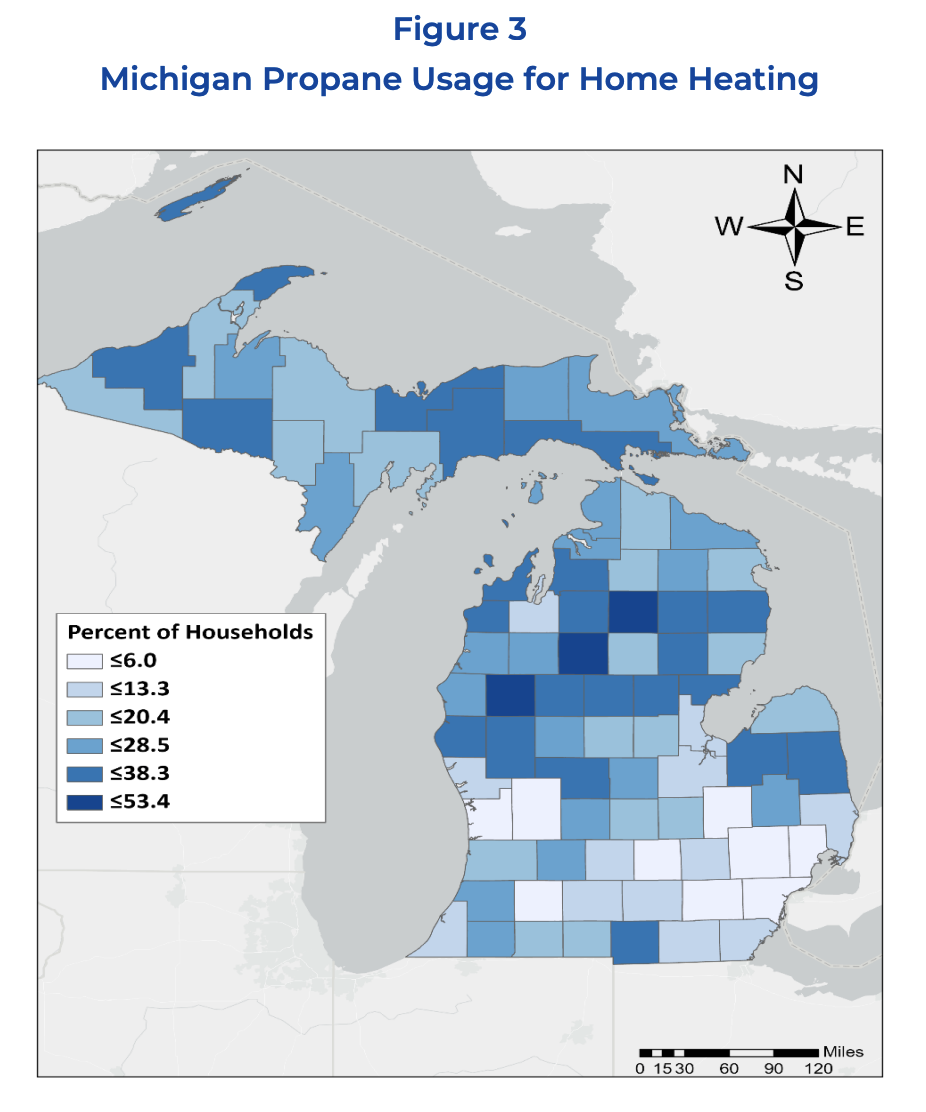
According to the EIA, approximately 5% of U.S. households heat with propane; however, in Michigan, the estimate is slightly higher, at more than 8%. In 2022, the EIA estimates Michigan’s residential sector consumed more hydrocarbon gas liquids (primarily propane) than any other state at nearly 370 million gallons. Areas of the northern Lower Peninsula and the Upper Peninsula have some of the highest proportions of total households using propane for home heating, with some counties topping 50% (see Figure 3). Weather remains the most significant factor in determining propane use for residents. Heating degree day (HDD) forecasts by the National Oceanic and Atmospheric Association (NOAA) indicate Michigan may experience near-normal temperatures throughout the 2024/25 winter heating season, totaling 5,311 HDD units, 3.6% higher than in 5,128 HDD units last year but essentially even (0.2% lower) than the 1981-2010 average of 5,321 HDD units. Another primary use for propane in the Midwest, including Michigan, is the drying of harvested corn crops. When corn crops are planted late in the spring or when fall is exceptionally wet, demand for propane from the agricultural sector may rise due to the increased need to dry down their crops for storage without a high risk of spoilage. As of October 28, 2024, most Midwestern states, including Michigan, Indiana, Illinois, Iowa, and Wisconsin, were all showing corn maturity progress ahead of the five-year average – an indication there will likely not be abnormal propane demand for grain drying this fall
Supply U.S.
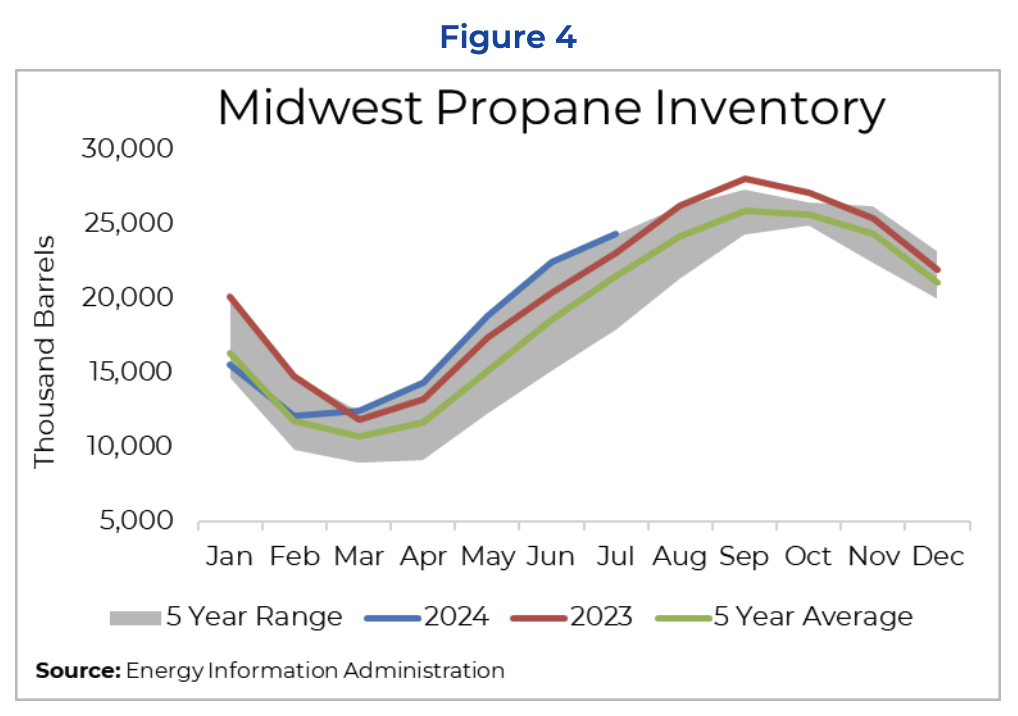
Propane production remains high – averaging 2.76 million b/d to end November as propane export demand continues to be strong. A significant portion of U.S. propane exports leaves from the Gulf Coast, destined for nations such as Japan, China, South Korea, and Mexico. The average Midwest propane production for the week ending November 22, 2024, was 555,000 b/d, an increase of 1.5% from the same period last year. According to the EIA, U.S. inventories of propane and propylene stood at 96.7 million barrels as of November 22, 2024, which is only 2% below the levels seen at the same time last year. PADD 2 (Midwest) propane and propylene stocks (see Figure 4) totaled 27.5 million barrels as of November 22, 2024 (up 400 thousand barrels from 2023), 10% above the five-year average for this time of year.
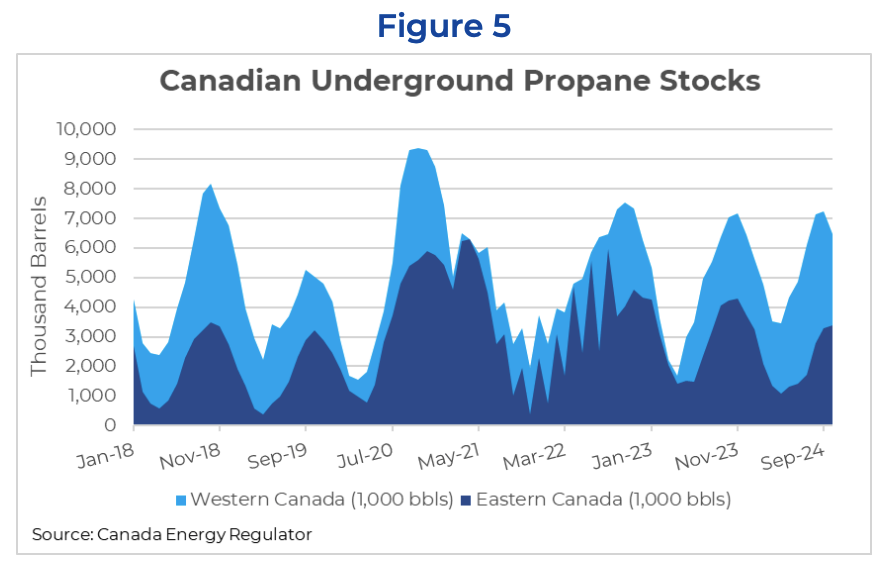
In addition to domestic propane supplies, many regions of the U.S. rely on imports from Canada, which are transported by pipeline, rail, and truck. Major Canadian underground storage facilities are primarily located in western Canada (Alberta) and in eastern Canada (Ontario). According to the MPSC’s 2019 Statewide Energy Assessment, approximately 18.7 million barrels of underground cavern storage capacity for hydrocarbon gas liquids, such as propane, are located in Ontario near the Sarnia and Windsor areas. According to Canada Energy Regulator data, underground propane stocks were expected to begin in October 2024, totaling 3.4 million barrels in eastern Canada and 6.5 million barrels in western Canada – 10% below and 0.2% above the five-year averages for the time period, respectively (see Figure 5).
Price
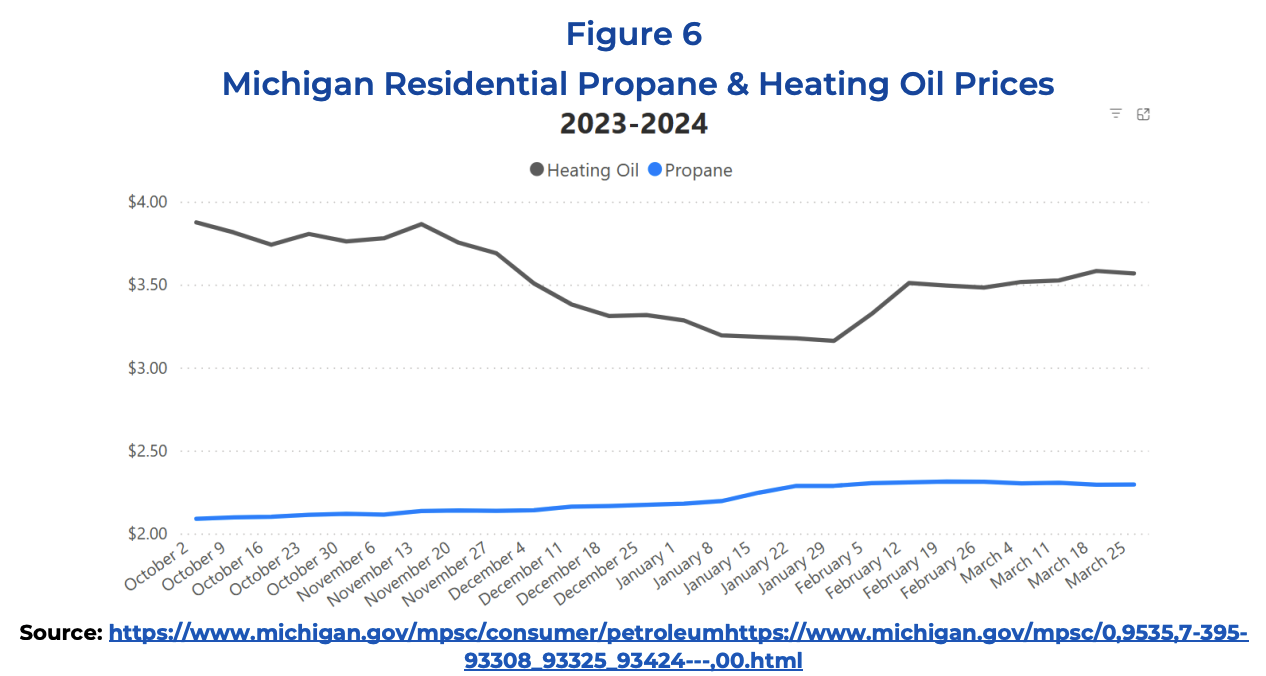
According to the EIA, wholesale propane prices in Michigan started this heating season at $0.93 per gallon (6 cents higher than prior year). However, oil and natural gas prices – which feed into propane prices – can at times be an upside risk for prices paid for propane later in the winter, especially during extreme cold events when demand is highest. For the week of November 25, 2024, the average residential propane price in Michigan was around $2.21 per gallon. As seen in Figure 6, propane prices were quite stable throughout last heating season.